
 Download a printable version of this publication. You may print and distribute this freely provided that it is printed without alteration.
To do so you will need to download and install the free Acrobat Reader.
Download a printable version of this publication. You may print and distribute this freely provided that it is printed without alteration.
To do so you will need to download and install the free Acrobat Reader.
What Every Woman Should Know about
-Tubal Ligation
-Sterilization by Tubal Inserts
-Sterilization Reversal
What is female sterilization?
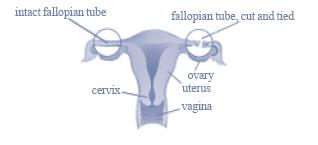
Female sterilization means making a woman permanently infertile, usually by cutting, tying, or blocking her fallopian tubes.
What are the fallopian tubes?
The fallopian tubes are two organs situated sideways in the lower abdomen attached to the uterus. They conduct the ovum from the ovaries toward the uterus and also nurture the ovum and the sperm. If fertilization occurs, the fallopian tubes nurture and transport the human embryo to the uterus.
What is tubal ligation?
Tubal ligation involves closing off the fallopian tubes by cutting, burning, tying, or fastening a clip (or a combination of these methods) to cause permanent sterility (infertility). It is a surgical procedure carried out under anesthesia.
Two common surgical procedures for getting one’s “tubes tied” are:
Laparoscopy: Usually small incisions are made in the lower abdomen. Carbon dioxide gas is pumped in to inflate the abdomen, and a fiber-optic light is inserted. Then, surgical instruments are insertedto cut, tie, or burn the fallopian tubes.
Mini-laparotomy: This procedure requires a small incision in the lower abdomen. The fallopian tubes are closed by clips, burned, or cut and tied.
What is non-surgical sterilization?
There is a new non-surgical method of permanent female sterilization. In a procedure called hysteroscopy, micro-inserts are passed through the vagina, cervix, and uterus, and placed in the fallopian tubes. The micro-inserts cause a tissue barrier to form that prevents sperm from reaching the egg.
Does female sterilization have health risks?
Risks from anesthesia and surgery
- Infection1
- Bleeding2
- Respiratory problems
- Adverse effects from anesthetics
- Damage to abdominal organs3
- Bowel perforation4
- Death
Risks from tubal ligation itself
- Menstrual disorders5
- Ovary dysfunction6
- Ectopic pregnancy7
- Remorse8
Long-term psychological effects such as depression and anxiety have been reported by women after tubal ligation.9 Stress interfering with sex has been reported in women after tubal ligation.10 The probability of undergoing hysterectomy within 14 years after sterilization is 17% per 100 procedures.11
Is sterilization 100% effective?
NO. Failure rates can range from 1% for laparoscopic sterilization up to 13% for hysteroscopic sterilization.12 When pregnancy occurs after a female sterilization procedure the risk for ectopic pregnancy is 7.3 per 1000 procedures and can be higher for the newest procedures.
Warning! Sterilization does not protect against
sexually transmitted diseases including AIDS.
What if I change my mind?
Many sterilized women later desire to have their fertility restored. Some have entered new relationships and want a child with their new partner; some want a return to physical wholeness; some believe that they have done something immoral and are seeking spiritual restoration. There are, however, significant obstacles to sterilization reversal; for example, the surgery is more extensive and expensive than the original procedure, and it is typically not covered by insurance. Also, a return of fertility is not guaranteed; the success rate varies depending on a woman’s age, the type of sterilization performed, and the skill of the surgeon.
Is sterilization morally acceptable?
Before 1930 no Christian church accepted sterilization or any form of contraception. The Catholic Church and some Protestant churches still teach that intentional sterilization is an immoral form of birth control.
What are my options?
If you are married, the modern methods of Natural Family Planning (NFP) are the safest, healthiest, and least expensive alternatives for family planning.
If you are single, abstinence is the best option and always works!
References
1. Levgur M, Duvivier R. Pelvic inflammatory disease after tubal sterilization: a review. ObstetGynecol Surv. 2000 Jan; 55(1): 41-50.
2. Magos A, Chapman L. Hysteroscopic tubal sterilization. Obstet Gynecol Clin North Am. 2004 Sep; 31(3): 705-19, xii.
3. Moore CL, Vasquez NF, Lin H, Kaplan LJ. Major vascular injury after laparoscopic tuballigation. J Emerg Med. 2005 Jul; 29(1): 67-71.
4. Westhoff C, Davis A. Tubal sterilization: focus on the U.S. experience. Fertil Steril. 2000 May; 73(5): 913-922.
5. Timonen S, Tuominen J, Irjala K, Maenpaa J. Ovarian function and regulation of thehypothalamic-pituitary-ovarian axis after tubal sterilization. J Reprod Med. 2002 Feb; 47(2): 131-136.
6. Holt VL, Cushing-Haugen KL, Daling JR. Oral contraceptives, tubal sterilization, and functional ovarian cyst risk. Obstet Gynecol. 2003 Aug; 102(2): 252-258.
7. Jamieson DJ, Hillis SD, Duerr A, et al. Complications of interval laparoscopic tubal sterilization: Findings from the United States Collaborative Review of Sterilization. Obstet Gynecol. 2000; 96: 997–1002.
8. Kelekci S, Erdemoglu E, Kutluk S, Yilmaz B, Savan K. Risk factors for tubal ligation: regret and psychological effects impact of Beck Depression Inventory. Contraception. 2005 Jun; 71(6): 417-420.
9. Luo L, Wu SZ, Zhu C, Fan Q, Liu K, Sun G. Psychological long-term effects of sterilization on anxiety and depression. Contraception. 1996 Dec; 54(6): 345-357.
10. Warehime MN, Bass L, Pedulla D. Effects of tubal ligation among American women. J Reprod Med. 2007 Apr; 52(4): 263-272.
11. Hillis, SD, Marchbanks, PA, Tylor, LR, Peterson, HB. Tubal sterilization and long-term risk of hysterectomy: Findings from the United States collaborative review of sterilization. The U.S. Collaborative Review of Sterilization Working Group. Obstetrics & Gynecology. 1997; 89(4): 609-614.
12. Gariepy A, Creinin M, Schwarz EB, Smith K. Reliabilityof laparoscopic compared to hysteroscopic sterilizationat 1 year: a decision analysis. Obstet Gynecol. 2011; 118: 273–9.
Where can I learn more about Natural Family Planning?
One More Soul (OMS) is a non-profit organization dedicated to spreading the truth about the blessings of children, the harms of contraception, the benefits of Natural Family Planning, and the virtue of chastity. We carry a wide variety of educational resources, including tapes, videos, CDs, DVDs, and books. Natural Family Planning classes are available each month in English and Spanish.
Please call us or visit our web site www.OMSoul.com for more information about tubal sterilization reversal.
Female Sterilization
What tubal ligation is; the physical, mental and moral consequences that a woman should consider before making the serious decision to become sterile; and what alternatives exist