
 Download a printable version of this publication. You may print and distribute this freely provided that it is printed without alteration.
To do so you will need to download and install the free Acrobat Reader.
Download a printable version of this publication. You may print and distribute this freely provided that it is printed without alteration.
To do so you will need to download and install the free Acrobat Reader.
1) How could the Pill cause breast cancer?
Two of the most important types of hormones that control reproduction are estrogens and progestins. Birth control pills are made from synthetic estrogens and/or progestins. Experiments have shown that these hormones cause women’s breast cells to divide more rapidly.1 Cells that divide more rapidly are more prone to develop into cancer cells.
2) What is the evidence that the Pill and breast cancer are connected?
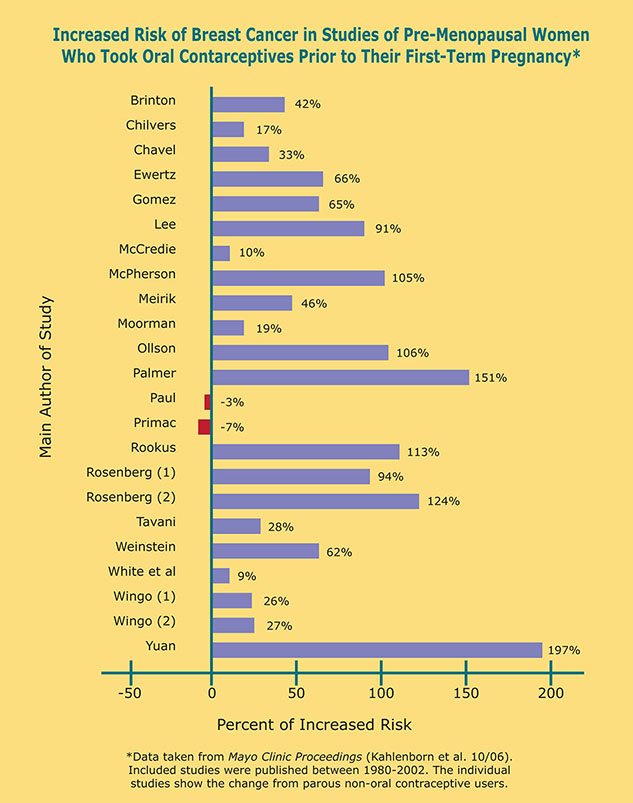
In 2005, the World Health Organization classified oral contraceptives as a Group I carcinogen—the most dangerous classification known.2 Also, a comprehensive meta-analysis3 published in the Mayo Clinic Proceedings in October 2006 found that 21 out of 23 retrospective studies done since 1980 showed that women who took oral contraceptives prior to the birth of their first child sustained a 44% average increased risk of developing pre-menopausal breast cancer (see research chart inside). This risk rose to 52% for women who took the Pill for at least four years prior to the birth of their first child.
3) How serious of a problem is breast cancer?
El cáncer de seno es la segunda causa más común de muerte por cáncer en las mujeres en los Estados
Unidos. Cerca de una en cada ocho mujeres desarrollará el cáncer de seno en alguna época en
su vida. En los EE.UU. cerca de 287.850 mujeres son diagnosticadas anualmente con cancer de
seno invasivo. y más de 43.000 mueren de esta enfermedad.4 La mitad de las mujeres que desarrollan el cáncer de seno tienen 62 años de edad o menos cuando se les realiza el diagnostico. Este riesgo es aun más alto cuando es combinado con otros factores de riesgo del cáncer de seno como el aborto inducido, el tratamiento con hormonas (tal como remplazo de estrógeno), la historia familiar del cáncer de seno, y otros.
4) Do some contraceptives cause more risk than others?
Yes. Research studies show that breast cancer risk is almost tripled for women who used Depo-Provera for 3 years or more before age 25.5
5) Are other types of cancer affected by oral contraceptive pills?
Oral contraceptives decrease the risk of ovarian and uterine cancer, while they increase the risk of liver, cervical and breast cancer.6 Since breast cancer is far more prevalent than the other three types of gynecological cancers, the Pill’s overall effect is detrimental to women.
6) Are there other risks from contraceptives?
Yes. Well known side effects of the Pill include an increased frequency of blood clots, high blood pressure, and heart attacks, as well as migraines, depression, loss of libido, and a variety of other disorders. Less well known is that oral contraceptives and injectable progestins (such as Depo-Provera) significantly increase the risk of contracting and transmitting HIV (the AIDS virus).7,8 In addition, medical studies strongly suggest that oral contraceptives work at times by causing an early abortion.9
7) How can I protect myself?
Many of the known risk factors for breast cancer can be avoided, such as hormone exposure (including hormonal contraceptives), induced abortion, heavy alcohol use, obesity, and radiation exposure. In addition, there is a significant reduction of risk with each child a woman bears. Every month of breastfeeding reduces breast cancer risk, as does bearing a child at a younger age. Some medications (e.g., raloxifene), which are taken after menopause to help strengthen bones, have been shown to markedly reduce the risk of post-menopausal breast cancer and should be considered by all women at high risk.10
8) If hormonal contraceptives are so dangerous, what options do couples have?
Natural Family Planning (NFP) methods are available and do not require chemicals or surgery and cause no increase in breast cancer risk. Not to be confused with the “rhythm method,” NFP is based primarily on observations of a woman’s cervical mucus. One of the largest research studies of NFP (involving 19,843 women and performed in India by the World Health Organization) showed a pregnancy rate of 0.2 pregnancies per 100 women yearly.11
Natural Family Planning methods have been used to diagnose and treat a variety of female reproductive disorders including infertility. Various medical problems (e.g., excessive menstrual cramping and bleeding), which are sometimes treated with contraceptive hormones, can often be treated by giving magnesium/calcium supplements and ibuprofen products after the onset of menses.
9) How can I find out more about breast cancer risk from the Pill?
Anyone may download the entire Mayo Clinic meta-analysis article by going to The Polycarp Research Institute (TPRI): Oral Contraceptive Use as a Risk Factor for Premenopausal Breast Cancer (TPRI) .In addition, eleven of the seventeen chapters in the book Breast Cancer, Its Link to Abortion and the Birth Control Pill deal with cancer risks from birth control pills.6
10) Where can I find information about Natural Family Planning?
Natural Family Planning information is available from a number of national organizations:
Billings Ovulation Method Association
www.Boma-usa.org (651) 699-8139
Liga de Pareja a Pareja
www.ligadepareja.org (800) 214-6028
FertilityCare Centers of America
www.fertilitycare.org (402) 505-8917
Fundación Familia de las Americas
www.familyplanning.net (301) 627-3346
Marquette Institute for Natural Family Planning
www.mu.edu/nursing/natural-family-planning.php
Natural Family Planning International
www.NFPandmore.org
SymptoPro
www.symptopro.org (971) 280-9676
US Conference of Catholic Bishops
www.usccb.org (202) 541-3240
One More Soul (Un Alma Más)
www.OneMoreSoul.com (800) 307-7685
Many Catholic dioceses have NFP offices or Family Life offices that can supply NFP information. Local parishes and Catholic hospitals may also be good sources.
References
1. Anderson T, Battersby S, et al. Oral contraceptive use influences resting breast proliferation. Hum Pathol. 1989; 20: 1139-1144.
2. World Health Organization International Agency for Research on Cancer. IARC Monographs. July 29, 2005.
3. Kahlenborn C, Modugno FM, et al. Oral contraceptive use as a risk factor for premenopausal breast cancer: a meta-analysis. Mayo Clin Proc. 2006; 81(10): 1290-1302.
4. American Cancer Society. Key Statistics for Breast cancer. Last revised: January 12, 2022. Retrieved from Breast Cancer Statistics | How Common Is Breast Cancer
5. Skegg DCG, Noonan EA, et al. Depot medroxyprogesterone acetate and breast cancer [A pooled analysis of the World Health Organization and New Zealand studies]. JAMA. 1995: 799-804.
6. Kahlenborn C. Breast Cancer, Its Link to Abortion and the Birth Control Pill. One More Soul, Dayton, 2000. Can be read or downloaded at www.onemoresoul.com/featured/breast-cancer-its-link-to-abortion-and-the-birth-control-pill.html.
7. Ungchusak, et al. Determinants of HIV infection among female commercial sex workers in northern Thailand: results from a longitudinal study. J Ac Immune Defic Syn Hum Retro. 1996. 12: 500-507.
8. Mostad SB, et al. Hormonal contraception, vitamin A deficiency and other risk factors for shedding HIV-1 infected cells from the cervix and the vagina. The Lancet 1997. 350: 922-927
9. Larimore WL, Stanford J. Postfertilization effects of oral contraceptives and their relationship to informed consent. Arch Fam Med. 9; 2000: 126-133
10. National Cancer Institute. Study of Tamoxifen and raloxifene (STAR) trial. April 26, 2006. (www.cancer.gov/star)
11. Ryder RE. “Natural Family Planning”: Effective birth control supported by the Catholic Church. Brit Med J. 1993; 307: 723-726.
Dr. Chris Kahlenborn practices Internal Medicine in Camp Hill, Pennsylvania, and is the current president of the Polycarp Research Institute (www.polycarp.org). He is the author of Breast Cancer, Its Link to Abortion and the Birth Control Pill, on which this pamphlet is partially based. This book (BBCL) is available from One More Soul at (800) 307-7685 for a suggested donation of $9.95 for the soft cover edition and $12.95 for the hardback, and can be read at www.OMSoul.com.
Breast Cancer, Its Link to Abortion and the Birth Control Pill is available from One More Soul at (800) 307-7685 for a suggested donation of $5.95 for the soft cover edition and $13.95 for the hardback.
More resources from Dr. Kahlenborn available at One More Soul
Breast Cancer: Abortion and the Pill
This booklet presents the summary, conclusions, and recommendations from Chapter 17 of the book Breast Cancer, Its Link to Abortion and the Birth Control Pill. A great resource for explaining just how dangerous abortion and contraceptive pills are. KBCL $1.00
Breast Cancer Risk from Abortion
Information from the book Breast Cancer, Its Link to Abortion and the Birth Control Pill, presented in a short and highly persuasive format. We have received letters and phone calls about babies saved from abortion when their mothers read this pamphlet. PBCA $0.35