Pope St. Paul VI reminds us that ideals are duties
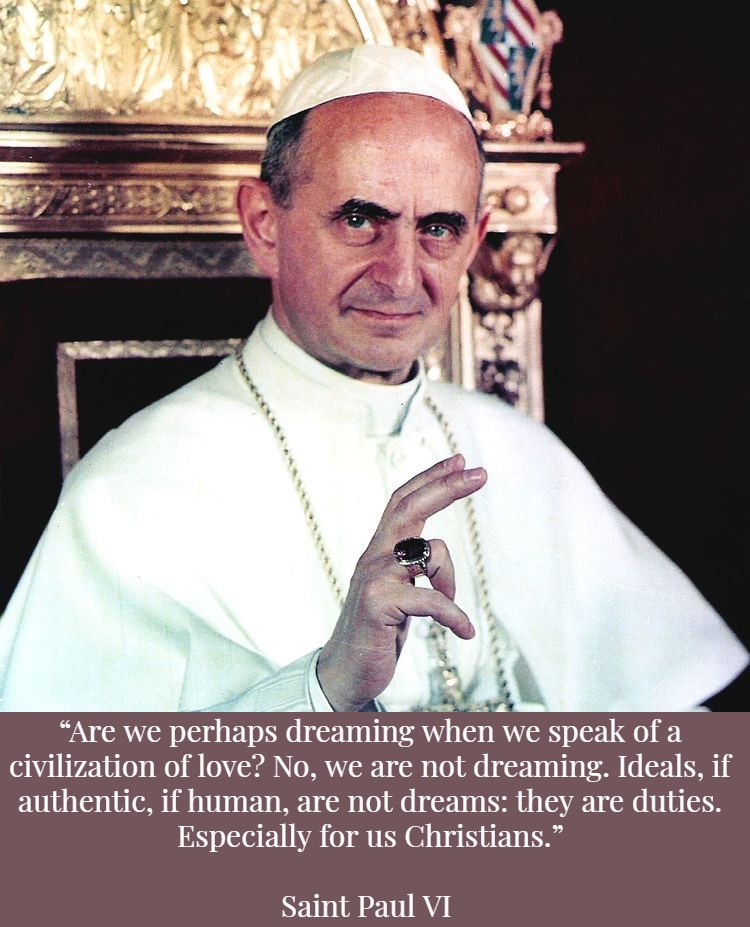
“Civilization of Love” is a phrase coined by Pope St. Paul VI around May 17, 1970. In a series of talks he explained that this civilization is the answer to a long catalog of miseries currently burdening the human race. Responding in advance to those who would dismiss this idea as a sort of “pipe dream,” the Pope said in his December 31, 1975, Angelus, “Are we perhaps dreaming when we speak of a civilization of love? No, we are not dreaming. Ideals, if authentic, if human, are not dreams: they are duties. Especially for us Christians.” (Google translation from the Italian.) He also adds that this general project of civilization based on love is a matter of great concern not only for Christians, but for anyone concerned with the welfare of the human race.
The Civilization of Love is a human society in which the relationships and structures are based on love rather than greed, domination, lust, or other typical human motivations.
“Love” in this context means doing something for another person without concern for consequences, positive or negative. Consider the love of a mother devoting herself to her child, especially visible when we see moms interacting with young babies. It is also easy to see this process of love in most families. It is, however, pervasive throughout societies, cultures, and nations, and is what makes human life tolerable, sometimes enjoyable or even delightful.
Societies (even some families) driven by other human motivators such as sexual pleasure, wealth of whatever kind, or dominance, quickly become highly unpleasant and often degenerate into a sort of hell on earth. We all have had experiences that reflect this, and human history is rife with societies (empires, dictatorships and the like) that follow this mode.
Social organization based on love has been crucial to the survival and phenomenal success of the human species. Babies and young children need an enormous amount of support just to survive and even more support to thrive. The fact that humans have been successfully reproducing since long before historic times indicates that mothers (and families) have been providing this sort of support from the very beginning. We can also see that nations, or parts of nations, where this type of culture is more prevalent are reproducing themselves, and those where this culture is weak or absent, are not.
Elements of the Civilization of Love can be found in ancient Jewish society as shown in various places in the Old Testament. Jesus, in his preaching, mentioned this sort of culture under the caption of “the kingdom of God,” a way of life characterized by such principles as, “give, and it shall be given to you,” (Luke 6:38) and “whatever you wish that men would do to you, do so to them” (Matthew 7:12).
The early Christian Church had many examples of communal living, but we do not see explicit Christian teaching on the dynamics of social life until 1891—in Pope Leo XIII’s encyclical Rerum novarum, which taught in detail of the duties of employers to their employees and vice versa, and the duty of governments to protect workers unjustly treated by conditions of employment. Leo’s teachings were re-emphasized and refined by his successors–especially Pope St. Paul VI (1971 and later), and Pope St. John Paul II. Paul VI and John Paul II made it clear that this whole doctrinal development was driving toward the Civilization of Love.
Paul VI explained how this model of society is not only possible, but necessary for the flourishing of the human species. John Paul II provided detailed explanations of the nature and workings of this civilization, for example: “If the first ‘way of the Church’ is the family, it should also be said that the civilization of love is also the ‘way of the Church’ . . . The family in fact depends for several reasons on the civilization of love, and finds therein the reasons for its existence as family. And at the same time the family is the center and the heart of the civilization of love.” (Letter to Families, section 13).
As people of good will, we need to take this idea and process it very seriously and promote it within ourselves and wherever we can.
Vince Sacksteder is the executive director of One More Soul.
Discover our suggested tools to build the Civilization of Love JPII – Just another One More Soul site. Support our mission with a donation through DonorBox.